

Top Hiring Challenges — And How to Address Them

Jen Dewar Avatar
A women with her elbows propped on her desk, with her hands in her head, as if she's feeling frustrated by hiring challenges
Top Hiring Challenges

    Get talent acquisition best practices, trends, and news delivered directly to your inbox.

    Most employers plan to increase (38%) or maintain (45%) hiring in the near future — but not without some issues. Evolving candidate expectations, emerging technologies, persistent talent shortages, and other factors can make it difficult to reach hiring goals and build a successful team.

    Manpower Group found that attracting qualified candidates is the biggest hiring challenge employers face by far, with 46% of employers citing this issue. That’s followed by filling complex technical roles (29%), improving candidate experience (26%), and managing a high volume of applicants (25%). AI usage is also a common issue, with 23% of employers reporting that learning the latest AI recruiter tools is a top challenge and 22% sharing that candidate usage of AI tools has become a hiring challenge.

    Understanding these challenges is the first step toward solving them. This article explores the most common hiring challenges organizations face today and provides actionable solutions you can implement to address them.
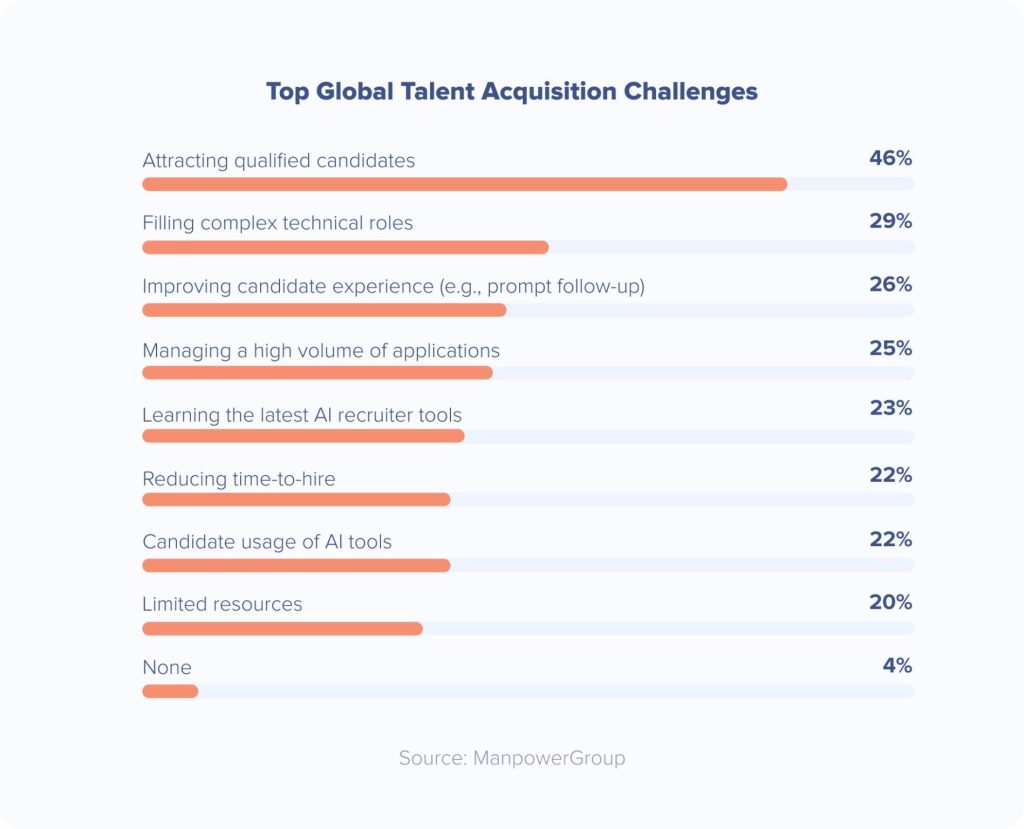
    Top Global Talent Acquisition Challenges

    1

    Attracting qualified candidates

    Nearly half of talent acquisition teams (46%) report difficulty attracting qualified candidates. Skilled talent may have several choices about where to work — or may not be looking for a new opportunity at all. The onus is on your team to get your job description in front of the right people and encourage them to apply.

    You can attract more qualified candidates by:

    • Leveraging your current team members to build your talent pipeline. Employee referral programs can be one of your most effective sourcing channels. Make it easy for employees to refer qualified candidates and provide context about why they’re a good fit so you can tap into networks you wouldn’t otherwise reach.

    • Expanding your sourcing strategy beyond the usual job boards. Build relationships with candidates before you need them, maintain a talent network, and reengage past applicants who might be a better fit for your current openings.

    • Writing engaging job descriptions. Clear, compelling job descriptions are crucial to convert talent into applicants. Your job postings should be transparent about compensation, responsibilities, and what makes your company unique.

    • Building a branded careers site. Use images, videos, and team profiles to help candidates visualize themselves in the role and understand your company culture.

    2

    Filling complex technical roles

    The talent pool for specialized positions is inherently smaller, and competition for these candidates is fierce. Technical roles also require specialized knowledge that can be difficult to assess. It’s no surprise that 29% of employers report challenges filling complex technical roles.

    You can overcome these technical recruiting challenges by:

    • Conducting thorough recruiting intake meetingsMeet with the hiring manager exactly what technical skills are required versus desired, and what the candidate will be responsible for accomplishing. Source a few candidates together and challenge requirements that might unnecessarily limit your candidate pool.

    • Implementing structured technical assessments. Skill assessments can take the form of coding challenges, technical questions, or practical exercises that simulate actual job tasks. This approach helps you identify candidates who can actually do the work, not just those who look good on paper or interview well.

    • Building relationships with technical communities. Attend industry meetups, participate in relevant online forums, and engage with technical content creators. These activities help you understand the technical landscape better while connecting you with passive candidates who might not be actively job searching.

    • Considering a partnership with external recruiters who specialize in technical roles. External recruiters may have access to a broader talent pool and specialized expertise that helps them better identify and evaluate talent. Partnering with a reputable recruiter can be an effective way to fill complex technical roles.

    3

    Improving candidate experience

    Candidate experience directly impacts your ability to hire quality talent and can make or break your recruiting success, but only one in four candidates are satisfied or very satisfied with the talent acquisition process. There’s certainly a lot of room for growth, though 26% of employers struggle to improve their candidate experience.

    Enhance your candidate experience by:

    • Streamlining your application process. Long, repetitive applications are one of the top reasons candidates abandon the hiring process. Ask only for information you truly need and save detailed questions for later stages.

    • Communicating proactively and promptly at every stage. Set clear expectations about your hiring timeline and stick to them. Even if you don’t have news to share, a quick update acknowledging where candidates stand in the process goes a long way. Automated reminders and status updates can keep candidates informed while freeing up your time for more strategic activities.

    • Providing feedback to candidates, especially those you’ve interviewed. While 65% of North American employers give feedback to internal candidates, only 17% give feedback to external and referred candidates. Most candidates (70%) said that receiving a clear reason for why they weren’t selected would leave them with a positive impression of the company.

    4

    Managing high volume of applications

    A quarter of talent acquisition teams (25%) struggle with managing high application volumes. The problem with high application volume isn’t just about time — it’s about ensuring you don’t overlook qualified candidates in the shuffle. It’s easy to miss a qualified candidate simply because their experience doesn’t jump off the page in the first five seconds of scanning.

    Effectively manage your application volume by:

    • Implementing an applicant tracking system that helps you filter and organize applications efficiently. Modern ATS platforms can help you quickly identify candidates who meet your baseline requirements, move multiple candidates through stages simultaneously, and keep detailed notes on each applicant.

    • Creating knockout questions in your application forms. Application screening questions can automatically filter out candidates who don’t meet essential requirements. This can give you more time to focus on the other applicants.

    • Rearranging your interview process. Play around with adding a screening interview, skill assessment, or AI interview at the beginning of your evaluation process to identify the most skilled talent early on.

    5

    Learning the latest AI recruiter tools

    Nearly a quarter (23%) of employers report struggling to learn and implement AI recruiter tools. The concern is understandable — implementing new technology requires time, training, and potentially a shift in existing processes. This is particularly challenging because AI technology is evolving rapidly. The tools available today might look quite different from those available a year from now.

    There’s also the question of which AI tools actually deliver value versus which ones are just riding the hype wave. It can be difficult to separate genuine innovation from buzzwords when so many vendors are promising to revolutionize your hiring process.

    Best practice to get started with AI recruiting tools include:

    • Start small and focus on specific pain points. Identify one area where AI could make the biggest impact rather than trying to overhaul your entire recruiting process at once. This might be sourcing candidates, screening resumes, or scheduling interviews.

    • Understand what AI can and cannot do. AI performs well at tasks like scanning resumes for keywords, scheduling interviews, answering common candidate questions through chatbots, and analyzing patterns in your hiring data. It doesn’t replace human judgment in evaluating culture fit, understanding nuanced candidate motivations, or building genuine relationships.

    • Invest in training for your team. The cost and time required for training is a legitimate consideration when implementing AI tools. Make sure everyone understands not just how to use the tools, but why you’re using them and how they fit into your overall recruiting strategy.

    6

    Reducing time to hire

    One in five employers (22%) are struggling to reduce time to hire, which can affect candidate engagement and hiring goals. Nobody likes a recruiting process that drags on unnecessarily.

    shorter time to hire helps you secure skilled candidates before they accept offers elsewhere — or simply drop out of your process because you’re not respecting their time.

    You can accelerate your hiring process by:

    • Using structured interviews to streamline your evaluation process. Planning your interview process and questions in advance allows you to eliminate unnecessary interview rounds and make faster decisions.

    • Implementing clear decision making criteria before you start interviewing. You can move from interview to offer much more quickly when everyone on your hiring team knows what you’re looking for and how you’ll evaluate it.

    • Streamlining interview scheduling. Connecting candidates with multiple interviewers can waste precious time with back and forth emails. Self scheduling tools allow candidates to pick available time slots directly from interviewers’ calendars, dramatically reducing coordination time.

    7

    Addressing candidate use of AI tools

    The flip side of recruiters learning AI tools is that 22% of talent acquisition teams now face challenges related to candidates using AI in the hiring process. This is a relatively new challenge that’s evolving as AI becomes more accessible to job seekers.

    Candidates might use AI to generate cover letters, polish their resumes, or even prepare for interviews with perfectly crafted responses to common questions. While some of this is simply candidates using available tools to present themselves well, it can make it more difficult to differentiate between candidates and assess their true abilities.

    Address candidate AI use by:

    • Providing transparent and straightforward guidelines. Let candidates know how you use AI in the hiring process — and how they can use it. For example, specify that candidates may use AI to proofread their resume, but that they cannot use AI to embellish their accomplishments.

    • Focusing your evaluation process on demonstrated skills rather than polished application materials. Skill assessments and practical exercises help you see what candidates can actually do, not just what they claim to be able to do.

    • Asking interview questions that require candidates to explain their thinking or describe specific experiences in detail. Use behavioral interview questions that ask candidates to describe specific situations they’ve handled. AI generated interview prep might help candidates answer surface level questions, but genuine experience shows through when you dig deeper into the how and why behind their work.

    8

    Working with limited resources

    One in five employers report struggling with limited resources. This challenge often compounds all the others — when you’re understaffed, underfunded, or both, every recruiting challenge becomes that much more difficult to address.

    There are many things you can do to maximize your impact with limited resources, such as:

    • Focus on efficiency in your recruiting processes. Eliminate manual, time consuming tasks wherever possible. Automate routine communications, use templates for common recruiting scenarios, and leverage technology to handle administrative work so you can focus on strategic activities.

    • Prioritize your open positions. Not every role needs to be filled immediately, and not every role requires the same level of effort. Identify which positions have the biggest business impact or are most urgent, and allocate your limited resources accordingly.

    • Make data driven decisions about where to invest your budget. For example, track your source of hire metrics to understand which sourcing channels deliver the best candidates. If employee referrals consistently produce high quality hires, invest more effort in your referral program rather than job board postings that don’t deliver results.

    • Leverage your entire team in the recruiting process. Hiring doesn’t have to fall solely on your talent team’s shoulders. You cab multiply your recruiting capacity without adding headcount when you make it easy for hiring managers and other team members to participate in sourcing, screening, and interviewing.

    • Build talent pipelines for your hardest to fill positions. Maintain relationships with promising candidates — even when you’re not actively hiring — rather than starting from scratch every time you have an opening. This approach reduces time to hire and recruiting costs when positions do open up.

    Final thoughts on these hiring challenges

    While some hiring challenges have been consistent over the years — such as too few qualified candidates or too many applications — others are just beginning to emerge. Few talent acquisition teams were concerned about candidates using AI tools a few years ago because those tools simply didn’t exist in their current form. Similarly, learning AI recruiter tools wasn’t on anyone’s radar as a top challenge.

    The key to navigating evolving recruiting challenges is to build flexible, scalable processes that can adapt as circumstances change. Invest in foundations that will serve you well regardless of the specific challenges you face — like strong employer branding, efficient workflows, and data driven decision making.

    Modern recruiting technology can help you address multiple challenges simultaneously while making your entire hiring process more efficient. JobScore’s applicant tracking system is designed to help hiring  teams overcome these common recruiting obstacles. From creating branded, mobile optimized careers sites that attract qualified candidates to streamlining interview scheduling and automating routine communications, JobScore eliminates the manual busy work that bogs down talent teams.