

Subscribe for updates
Get talent acquisition best practices, trends, and news delivered directly to your inbox.
By entering your email, you agree to receive marketing emails from JobScore
You might think there’s nothing left for a recruiter to do once the interview is over.
That couldn’t be further from the truth.
In this guide, we cover simple, low-cost ways to measure candidate experience after recruitment — and to keep improving your process over time.
1
Track Your Net Promoter Score
If you track nothing else, track this one metric: your Net Promoter Score (NPS) — one of the strongest indicators of candidate experience quality.
You don’t need to send it to every candidate; focus on those you’ve interviewed once or twice, who already understand how your company works. To measure it, send a candidate experience survey that asks them to rate, on a scale of 1–10, how likely they’d be to recommend your company as a great place to work.
Then split respondents into three groups:
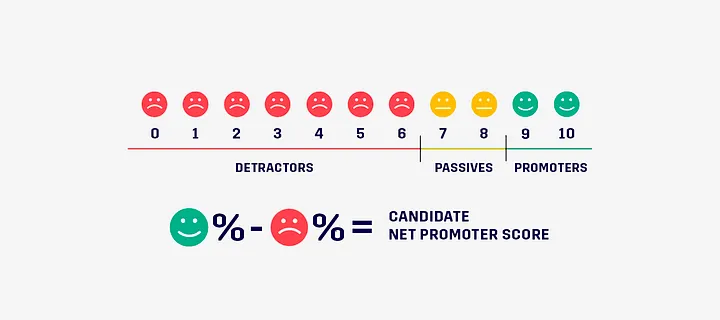
The Harvard Business Review notes that promoters are the most likely to send referrals your way, while detractors are the most likely to discourage their friends from applying.
With sites like Glassdoor, having more promoters than detractors matters even more — reviews reach people far beyond an employee’s own network.
NPS is great for an overall read, but it doesn’t capture the smaller details: it asks one broad question and rarely lets candidates explain their score.
2
Ask Candidates for Feedback
Another low-cost way to measure candidate experience is to send feedback surveys with your emails — even to rejected candidates. Those who accept, decline, or don’t make it all have insights to offer, and they help you check whether your company comes across the way you intend.
To improve your before-interview process, try asking:
And to gauge the overall recruitment process:
Focus on the answers you most want to know and keep the survey short — pick your top five questions. Let applicants know their responses are anonymous, and if response rates are low, consider a small incentive like a gift card.
3
Read Online Reviews
Online reviews are another readily available signal. It can be uncomfortable to read unfiltered opinions about your employer brand, but they hold some of the most valuable feedback for measuring and improving candidate experience. The most common review and social sites include:
Reviews aren’t only for measurement — they’re another chance to shape the experience, by responding thoughtfully and acting on the patterns you see.
4
Track Dropout Rate
A more direct measure is how many candidates drop out of the application process. If you reach out for an interview and never hear back, that’s a drop-out — as is a candidate who goes quiet before a follow-up, or who accepts another offer first.
Some will decline for reasons outside your control; roughly 17.3% of candidates reject an offer outright. The key is to watch for patterns that point to a fixable weak spot in the experience.
Whatever you measure, keep a shared list of your most important benchmarks and put it in front of the team — simply keeping it top of mind reinforces the behaviors that drive improvement.
5
Schedule Time for Internal Feedback
Improving the candidate journey takes consistent effort, which means keeping it front of mind for recruiters. Schedule a monthly meeting with your recruiting team to review the process’s strengths and weaknesses, drawing on:
Don’t focus only on what needs to change — celebrate wins, too. Share positive survey feedback, recognize the managers involved, and point out the behaviors behind good trends.
6
Change One Thing at a Time
If you’ve found a part of the experience that isn’t working, resist the urge to overhaul it overnight. Small, tracked changes make it much easier to see what’s actually driving the difference.
Borrow from A/B testing: change one thing for some interviews and keep the rest the same. You might add a step, change tactics, or reintroduce a skipped one — for example, does listing the starting salary screen candidates more effectively? Does a peer interview lead to a better hiring decision?
Track what you change, and note when it has a positive impact.
7
Share Wins Often
To keep improving, you’ll need buy-in from executives to invest more time, money, and resources as they become available.
You don’t need a formal presentation. Have someone take notes at your recurring feedback meeting, pull the highlights, and send a short recap to leadership — consistent, visible improvements earn greater buy-in over time.
Final Thoughts: How To Continuously Measure and Improve Candidate Experience
You won’t get everything about your candidate experience right the first time — and that’s normal. It’s less about perfecting the process upfront and more about trying something and refining it.
Focus on collecting enough meaningful information to make strategic adjustments, even on a limited budget: track your NPS and dropout rate, and gather feedback through surveys.
Do that consistently and you’re far more likely to deliver a great candidate experience — and to keep getting better at it.
Continue improving your hiring process with JobScore, the recruitment software that’s simple and effective.