The talent market is tricky right now. Nearly three-quarters of employers (74%) report difficulty filling roles, while candidates face more competition than ever before.
These recruitment statistics reveal what’s working, what’s broken, and how forward-thinking talent acquisition teams are adapting to win in 2026’s competitive hiring market.
46% of employers say attracting qualified candidates is their top challenge
If you’re having trouble building a skilled talent pipeline, you’re not alone.
Finding qualified candidates tops the list of global talent acquisition challenges, with 46% of employers citing it as their biggest struggle. This is followed by filling complex technical roles (29%), improving candidate experience (26%), and managing a high volume of applications (25%).
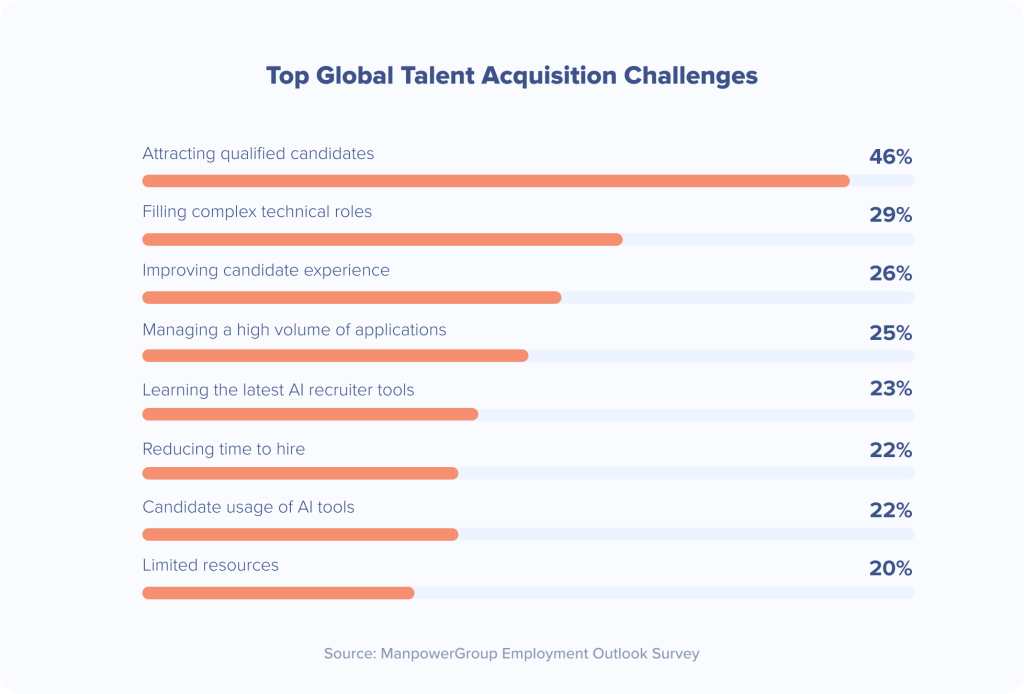
Most companies (68%) say the top of the funnel is their weakest link, with many relying primarily on job boards to attract candidates. This over-reliance on a single channel limits access to passive candidates and makes it difficult to stand out among thousands of employers.
Don’t wait for candidates to come to you. Build proactive sourcing strategies and nurture talent pipelines from your talent community, past applicants, and silver medalists who were strong candidates for previous roles. Organizations with pre-built pipelines are 2X faster to hire and have a 3X higher offer acceptance rate.
52% of employees are open to leaving their current role
More than half of people globally (52%) are looking for a new role in 2026. This represents an enormous opportunity for talent teams to expand their talent pool, though it also creates some issues.
Nearly two-thirds (65%) of people say finding a job has become more challenging, citing competition as the main hurdle. In fact, applications per role have doubled since the spring of 2022.
This surge in applications doesn’t necessarily mean more qualified candidates — it often means more time spent screening resumes. Unsurprisingly, 25% of employers cite managing high application volumes as a top hiring challenge.
Employers are increasingly turning to technology to manage this volume, with 48% of hiring managers using AI to screen resumes and job applications. The right tools can help you quickly identify and engage your most qualified talent.
62% of candidates prioritize compensation when job searching
Job seeker priorities haven’t changed much in recent years. Compensation, work-life balance, and flexible work arrangements continue to top the list of candidate priorities when they’re considering a new job.
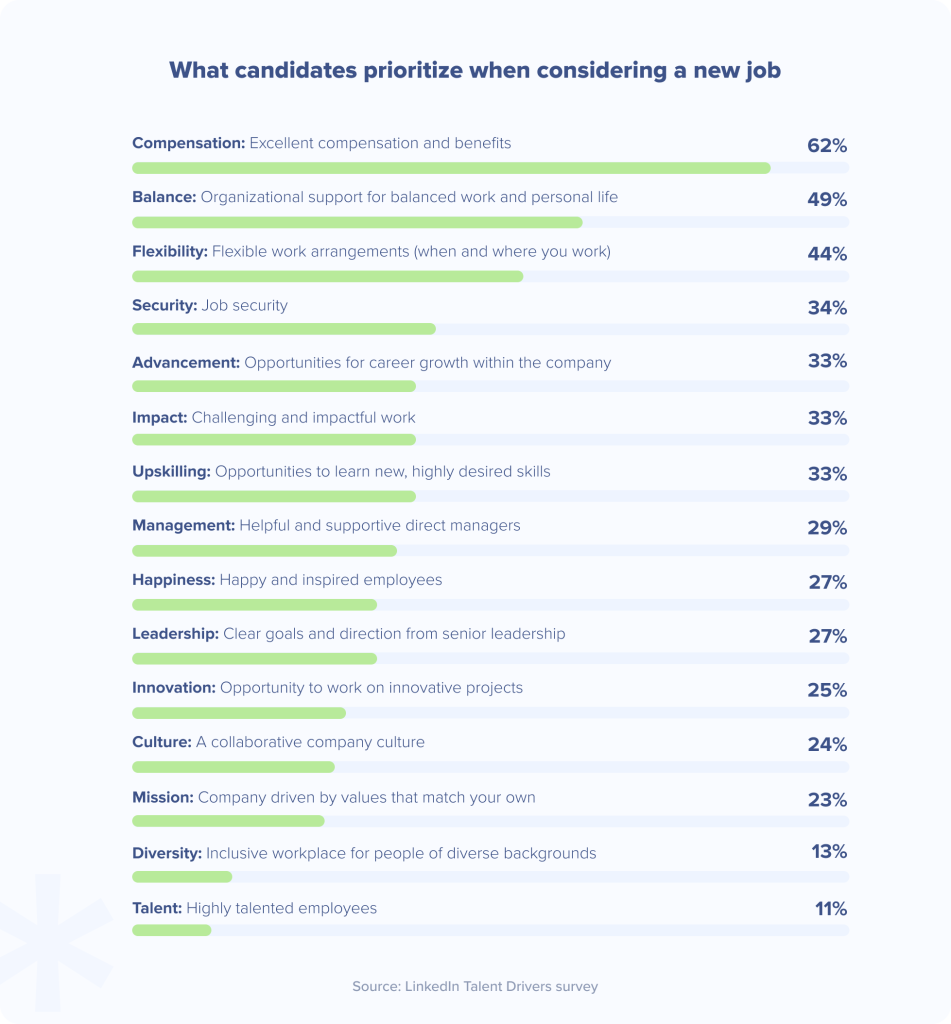
Keep in mind that every candidate is different and will have unique priorities. For example, three in 10 workers would be willing to take a lower salary in exchange for more upward mobility on the job. And 3 in 5 knowledge workers (59%) would choose a 4-day week fully in the office over a 5-day week fully remote. Be upfront about what your organization offers so candidates can self-select job opportunities based on their own priorities.
43% of candidates abandon applications after starting
Application abandonment may represent a massive leak in your recruitment funnel. Nearly half of candidates who begin an application process never complete it, citing complexity, mobile inaccessibility, and unclear expectations as common issues.
Think about the investment required to attract each applicant to your job posting, then consider losing nearly half of them before they even submit their application. This abandonment wastes your sourcing spend and reduces your candidate pool.
Improve your application completion rate by:
33% of candidates withdraw because their time was disrespected
The top three reasons North American candidates withdrew from recruiting processes tell a clear story about what matters most. Time being disrespected leads at 33%, followed by salary not meeting expectations at 28%, and the recruiting process taking too long at 16%.
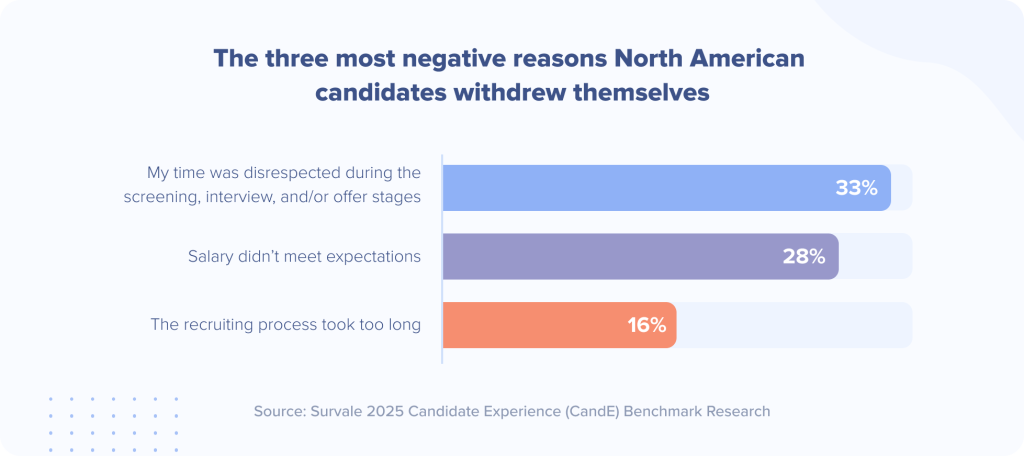
Candidates are evaluating your organization as carefully as you’re evaluating them. When you waste their time through disorganized interviews, delayed responses, or an unnecessarily long process, you signal that you won’t respect their time as an employee either. In fact, 42% of candidates have left the recruitment process when it took too long to schedule an interview.
Respect your candidate’s time at every stage:
87% of U.S. employees say reputation influenced their job decision
Your employer brand is an important factor in candidate decision-making. Most job seekers (83%) research company reviews and ratings when deciding where to apply for a job. A slightly higher percentage (87%) say reputation influenced their decision to take their current role.
Invest in your employer brand as a strategic priority:
Employer branding is an impactful way to address hiring challenges this year. For example, 71% of Glassdoor users say their perception of a company improves when an employer is active on the platform and 70% say they’re more likely to apply. And employers who boosted their overall Glassdoor rating by at least 0.5 points saw 20% more job clicks and 16% more apply starts on average.
48% of employers rate their hiring process as “good”
Most employers report their hiring process is effective at selecting the right people for the right roles, but only 19% rate it as “excellent” and 48% say it’s merely “good.” This suggests significant room for improvement in how most organizations evaluate and select candidates.
The interview stage is particularly problematic. Half of companies report interview processes that take over four weeks, and 42% have candidates undergo five or more interviews before a decision is made. Meanwhile, 55% of candidates say the interview process feels disorganized or inconsistent, and only 19% of companies report that hiring managers consistently follow interviewer recommendations.
Standardize your hiring process to improve consistency and quality:
Your recruitment action plan
These recruitment statistics offer best practices and opportunities for improvement. Use this checklist to strengthen your talent acquisition process:
Final thoughts on these recruitment statistics
The organizations winning in this competitive talent market aren’t necessarily those with the biggest budgets. They’re the ones who understand what candidates value, remove friction from their processes, and create experiences that respect the candidate’s time.

Subscribe for updates
Get talent acquisition best practices, trends, and news delivered directly to your inbox.
By entering your email, you agree to receive marketing emails from JobScore